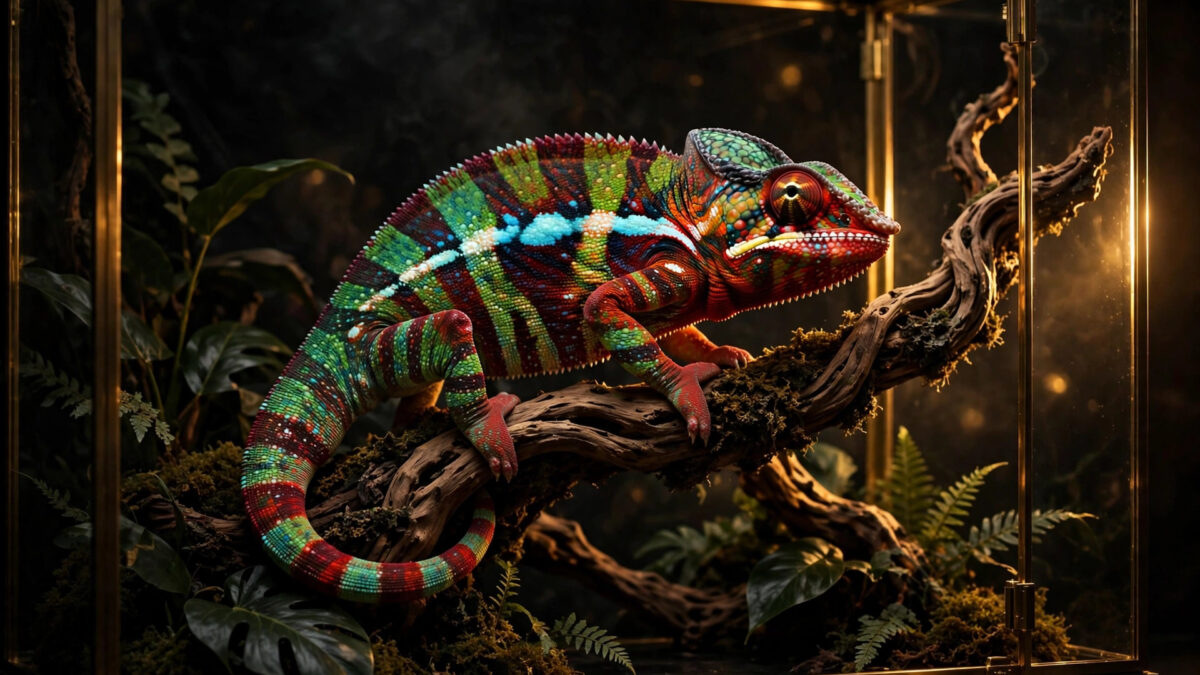
A panther chameleon does not need a decorated box. It needs height, living cover, clean moving air, and light that keeps time. Build a tall, planted vivarium as a serious piece of furniture, get the misting and lighting right, and the animal settles into what it is: a slow, colour-shifting jewel on display.
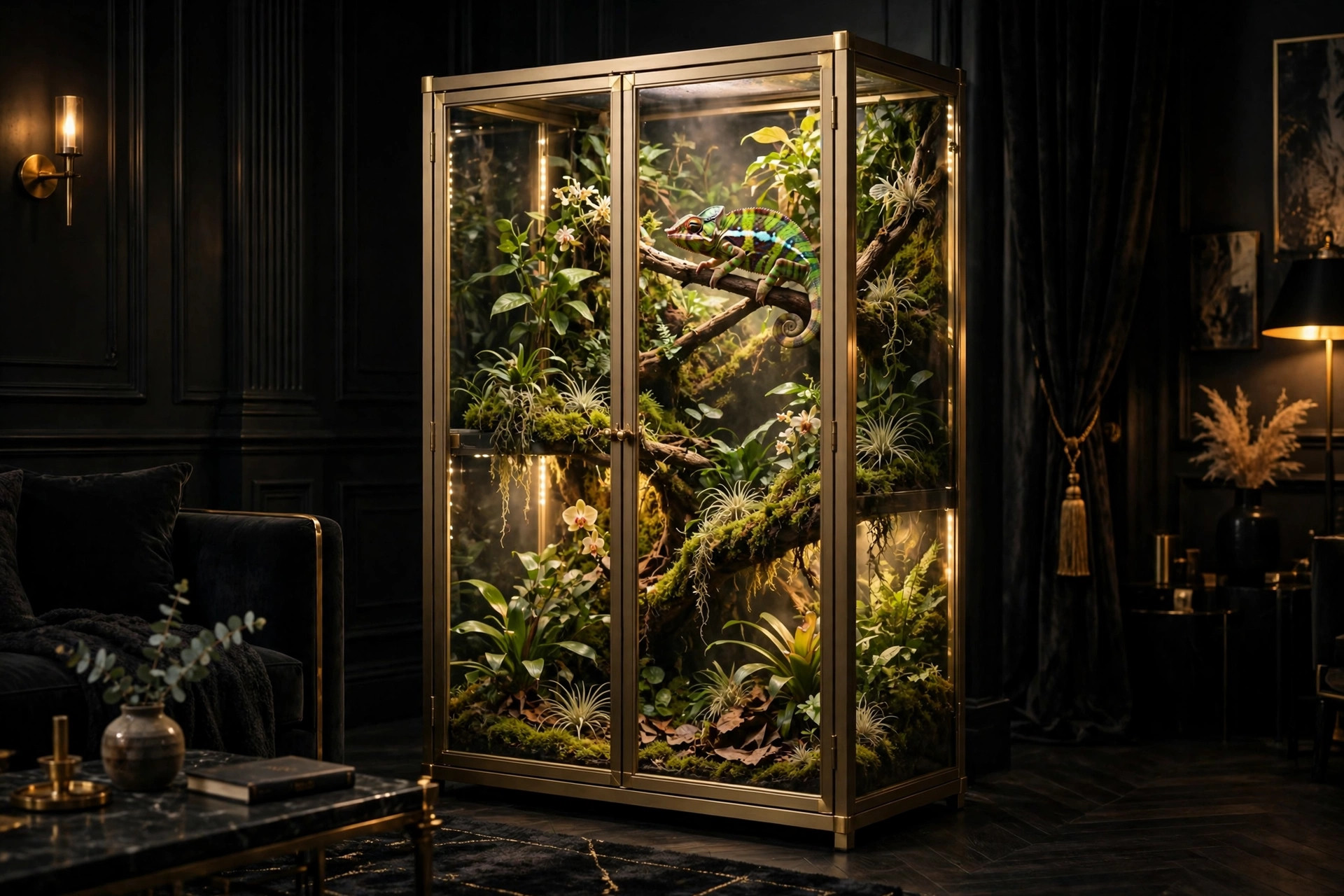
What does a panther chameleon actually need from a vivarium?
Four things, and none of them is optional: (1) vertical space to climb and claim height; (2) live planting and branches at several heights; (3) precise misting and airflow so humidity stays in range without stagnant air; (4) full-spectrum lighting on a strict day rhythm. Miss one, and the rest stops working properly.
Height comes first because this is an arboreal animal. A panther chameleon spends its life above the ground, choosing a perch, watching from it, sleeping on it. A low, wide tank asks it to live in the wrong shape of world.
Planting and branches give that height structure. Without layers to move through and leaves to hide behind, a tall enclosure is just empty air. The animal needs routes up, across, and down, plus shade it can retreat into on its own terms.
Misting, airflow, and light are the invisible parts. They do not photograph as well as brass framing or a sculptural branch. They are, quietly, the difference between a vivarium that looks refined and one that actually sustains the animal inside it.
Choosing the enclosure as a furniture piece
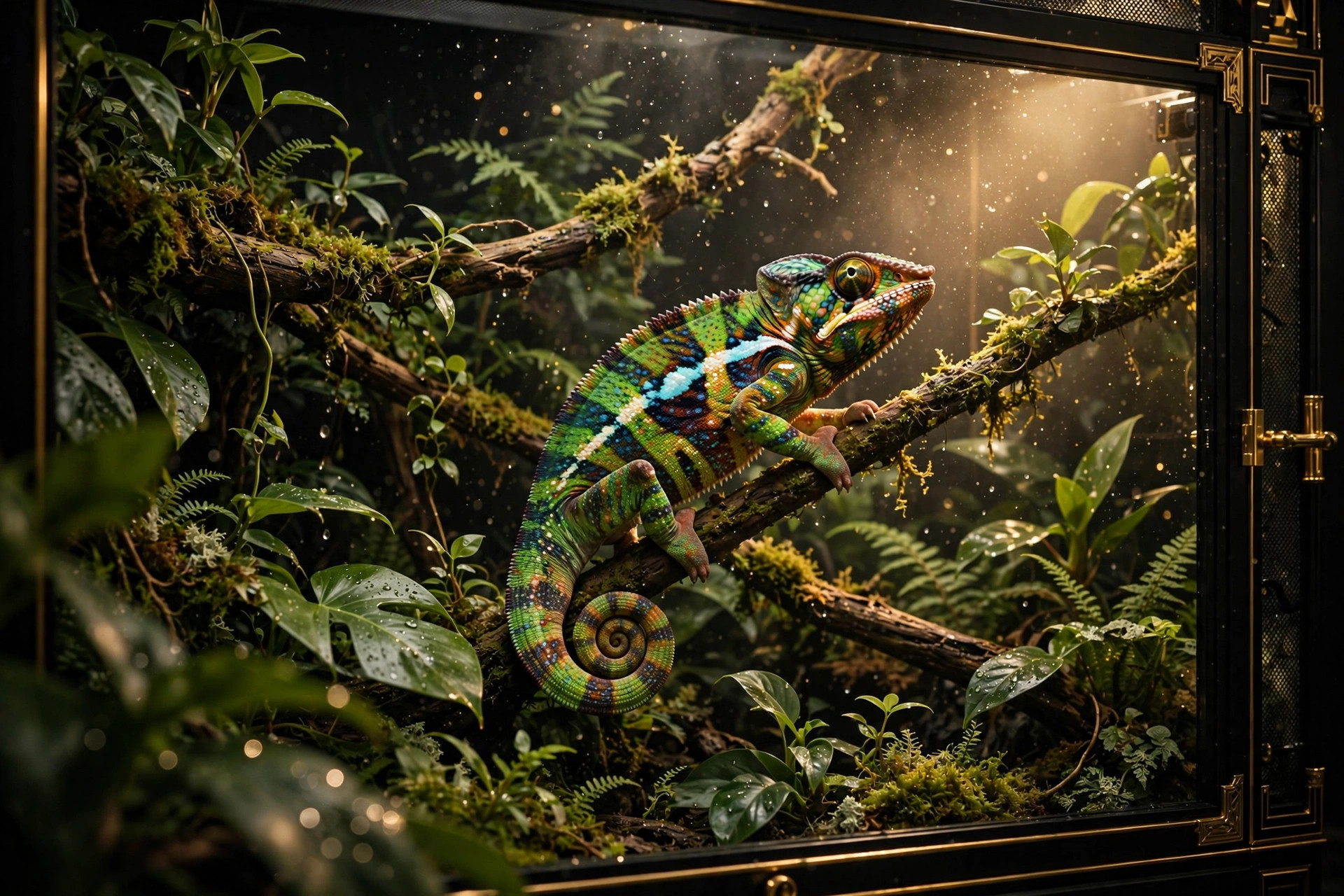
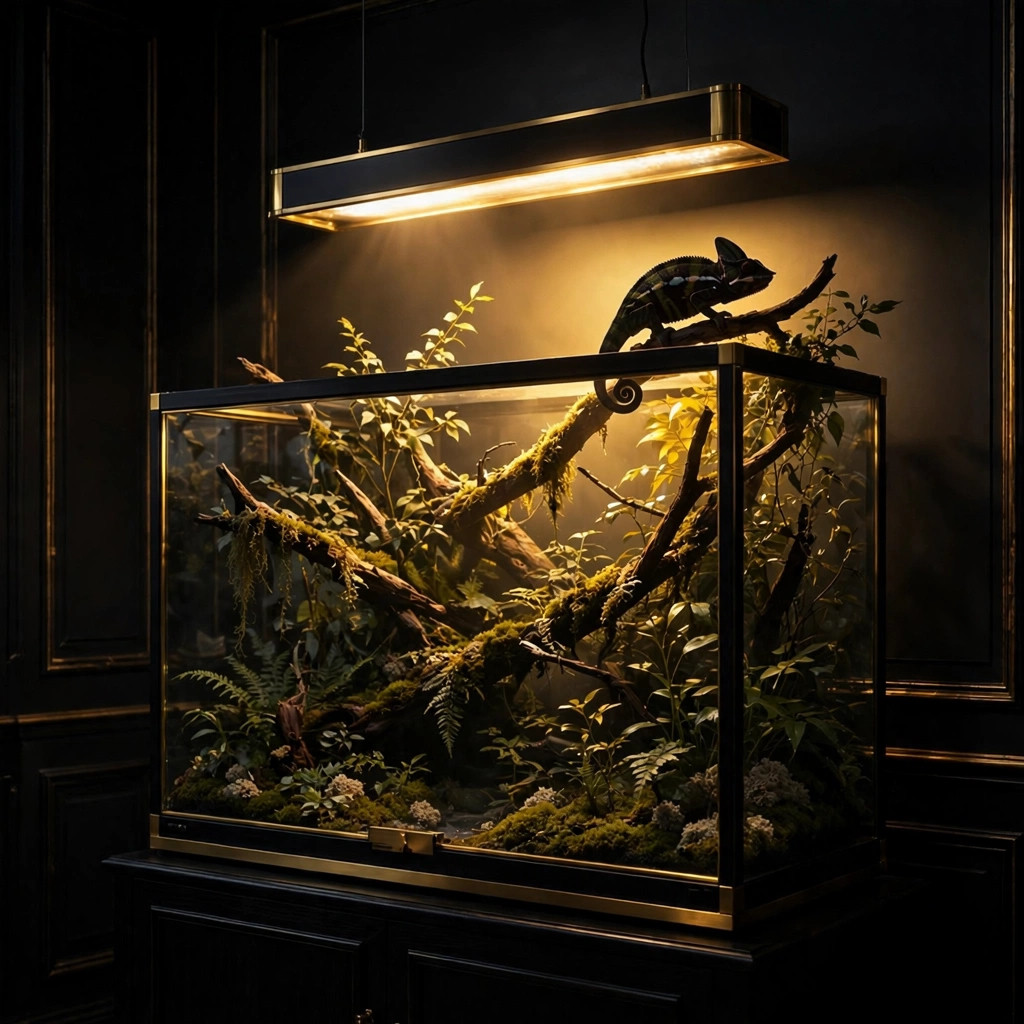
Start with proportion. A furniture-grade vivarium for this species stands tall rather than sprawling low, with a vertical front that reads like a cabinet or a framed picture window in the room. That height serves the chameleon, and it also gives the piece presence.
Frame materials change how the whole thing sits in a space. Matte black metal feels architectural and quiet. Brass detailing feels warmer, closer to a classic conservatory piece. Either can work, provided the frame is rigid, the doors seal cleanly, and the panels do not flex or rattle when you open them.
Glass gives you the clearest view and holds humidity well. Mesh panels give you airflow, which chameleons need, but they let moisture escape faster. Many well-built designs mix the two, glass where you look and plant, screened sections where air needs to move.
What to look for before you fall for the finish
Check the boring details first. Doors should open without shaking the branches inside. Locks should feel solid. Cable and misting-line entry points should be neat and sealed, so you are not drilling holes or trapping wires later.
Look at drainage, too. A planted vivarium misted daily produces runoff. A proper base, a drainage layer, or a discreet drain saves the floor beneath and stops water sitting where it should not.
Standard tank or furniture-grade vivarium?
Both can house a chameleon if the husbandry is right. They differ in how much work they ask of you, and in how they live in a room day after day.
| Dimension | Standard glass tank | Furniture-grade vivarium |
|---|---|---|
| Orientation | Often low and wide, built for ground-dwelling species | Tall and vertical, built around climbing and height |
| Ventilation | Limited, usually a single mesh lid | Planned airflow, screened sections placed by design |
| Planting depth | Shallow substrate, little room for rooted planting | Deeper base that supports live plants and drainage |
| Lighting integration | Fixtures sit on top, exposed and improvised | Lighting housed or aligned with the frame, cables hidden |
| Misting | Hand sprayer, or lines added as an afterthought | Misting lines routed discreetly through the frame |
| Presence in a room | Reads as equipment | Reads as a piece of furniture |
The table is not a licence to buy the expensive option and relax. A beautiful enclosure with poor airflow or lazy lighting still fails the animal.
How should planting and branches be arranged inside?
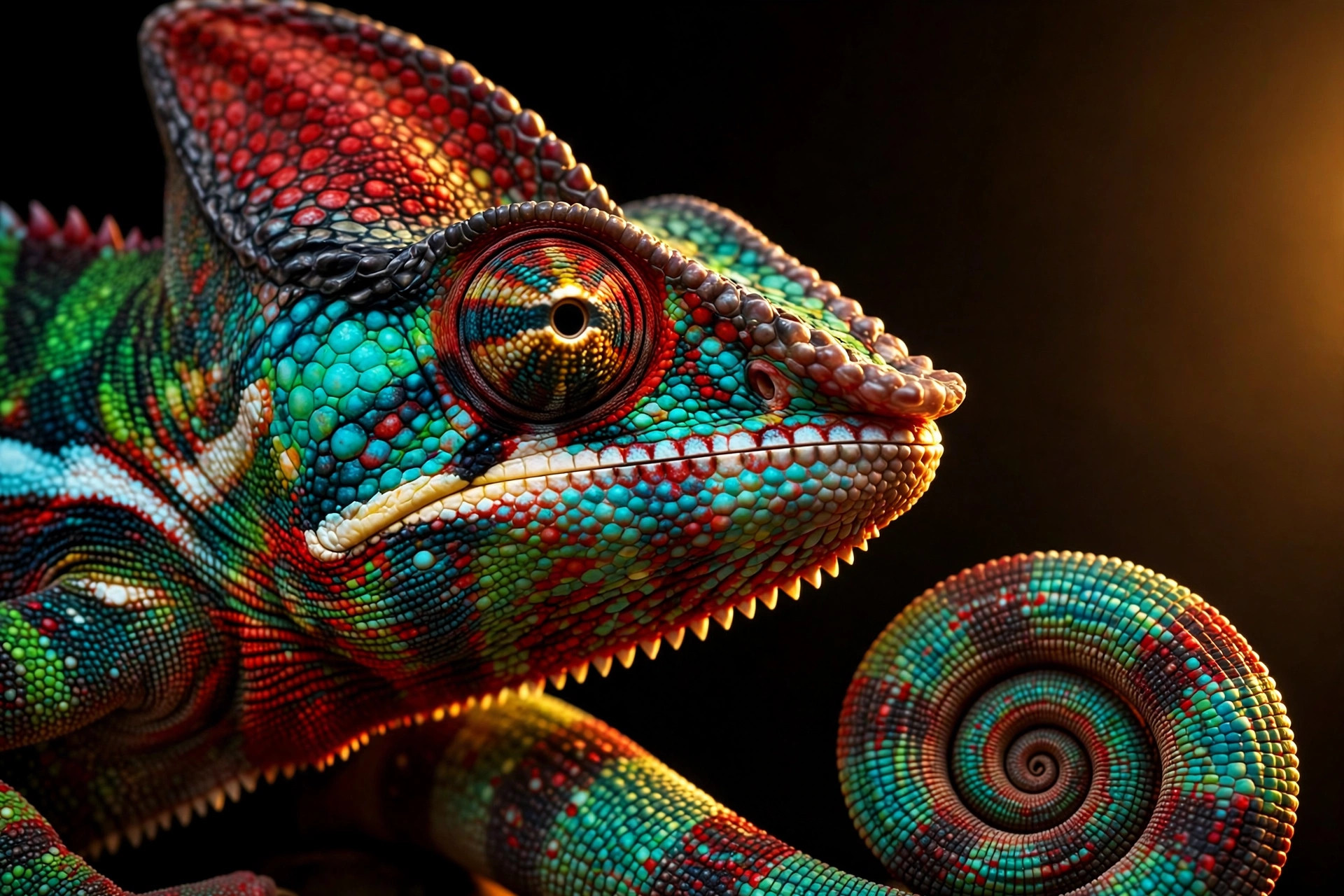
Arrange the interior in layers: sturdy horizontal branches at several heights, one clear basking perch near the top, and dense live planting in the middle and lower zones for cover. Leave the highest perch fairly open. The chameleon needs both exposure and retreat, and it should choose between them itself.
Think in routes, not objects. A branch that leads nowhere is decoration. A branch that connects the basking spot to a shaded cluster of leaves, and from there down toward the lower planting, becomes a path the animal will use all day.
Choose branches with varied thickness. Feet built for gripping do better on natural, uneven diameters than on one smooth dowel repeated everywhere. Angle a few diagonally, too. Real canopies are not ladders.
Plants that earn their place
Pick sturdy, non-toxic live plants that can take daily misting and support some weight. A tall central plant can form the spine of the layout. Trailing plants soften the edges and create curtains of cover. Smaller plants fill the lower level, where the air stays cooler and more humid.
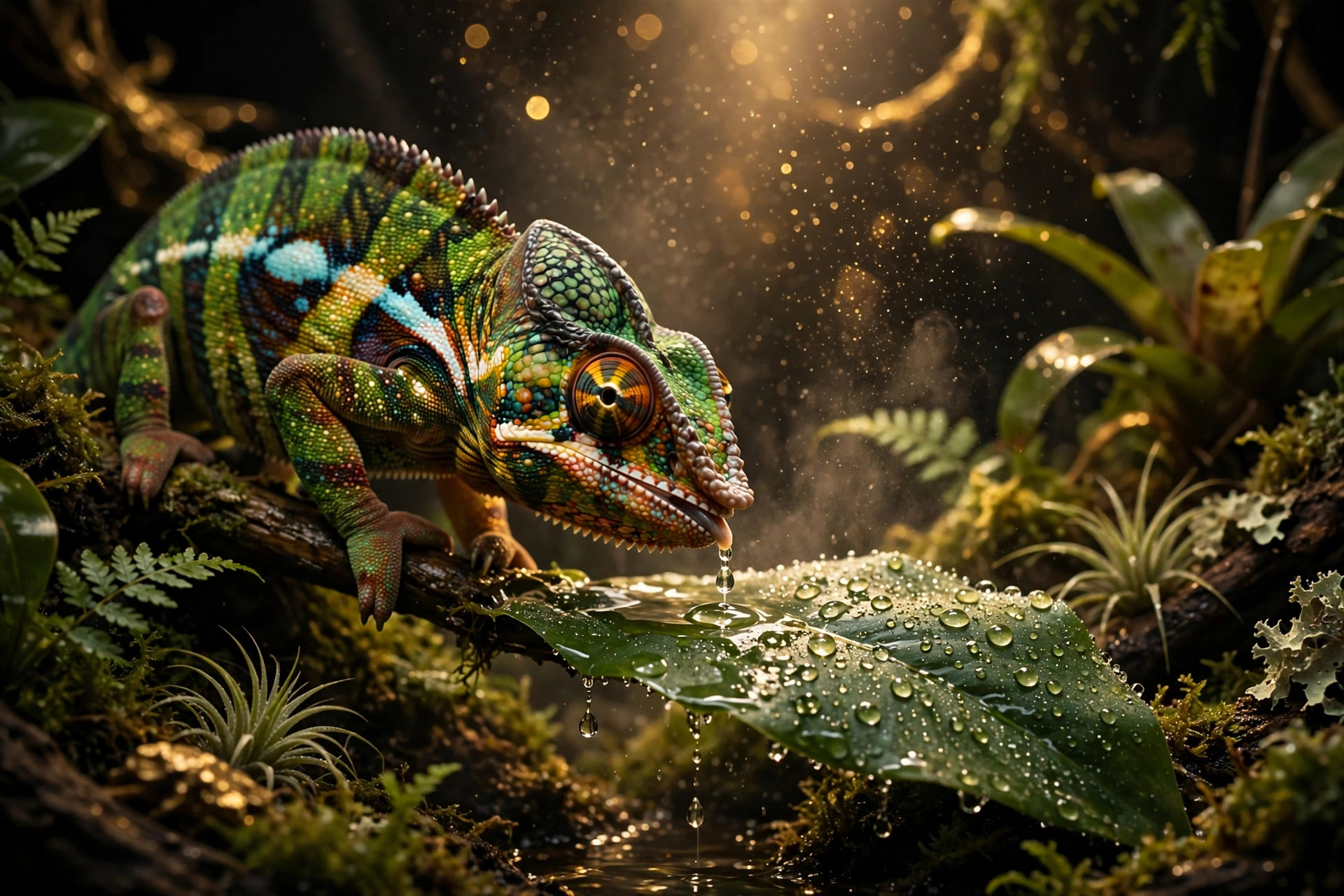
Live planting does more than look good. Leaves hold droplets the chameleon can drink from. Foliage breaks up sightlines, which lowers stress for an animal that would rather not feel watched from every angle. Roots and soil also help the enclosure hold a steadier humidity pattern between mistings.
Expect to prune and replace. Plants grow toward the light and thin out in shade. A planted vivarium is a small garden under glass, and it needs the same light editing a garden does.
How do misting and lighting work together day to day?
They run on a shared clock. Lights come on in the morning and go off at night, on the same schedule every day, with a proper period of darkness between. Misting sessions fall around that rhythm, usually before lights-on or early in the lit period and again later, so leaves are wet when the animal is active and drinking.
Panther chameleons drink droplets, not still water from a bowl, as a rule. Misting coats the leaves, and the chameleon laps from them. Sessions should wet the planting thoroughly without turning the enclosure into a swamp. Between sessions, the leaves should mostly dry. Constantly sodden interiors invite trouble.
Airflow is the partner nobody sees. Screened panels and gentle room air movement let the enclosure breathe between mistings. Humidity can rise and fall in a natural arc instead of sitting high and stale. You want that arc. Stagnant, saturated air is the quiet failure mode in many handsome setups.
Light as both husbandry and design
This species needs full-spectrum lighting, including UVB, provided at the right distance from the basking perch and replaced on the maker’s schedule, since output fades long before a bulb looks tired. A separate basking source gives a warm spot near the top. The rest of the enclosure should grade down into cooler shade.
Good design hides the hardware without hiding the light. Fixtures aligned with the frame, cables routed out of sight, and timers doing the daily switching keep the piece looking composed.
Check temperatures at perch level, not at the glass. A thermometer in the wrong place tells a reassuring lie. Measure where the animal actually sits, warm zone and shade alike.
The daily rhythm of a well-kept vivarium
Mornings are simple. Lights on, a misting session, a quick look at the animal and the planting. Is the chameleon alert and positioned where you would expect? Are the leaves holding droplets? Small observations, done daily, catch small problems early.
Feeding fits into the lit hours. Offer appropriately sized live insects, gut-loaded and lightly dusted according to a sensible supplement routine agreed with current care guidance or a specialist vet. Remove uneaten insects that could bother a sleeping chameleon at night. Keep notes if you can. Appetite changes are easy to miss without them.
Evenings matter just as much. Lights off on time, every time. This is a day-active animal, and darkness is part of its care, not an absence of care.
Weekly jobs are unglamorous. Wipe glass, check misting nozzles, trim plants back from the lights, confirm timers still run true. None of it takes long.
Honest limits, stated plainly
A panther chameleon is an observation animal. That phrase gets used a lot, and it means exactly what it says. You keep this species to watch it, not to hold it. Regular handling stresses most chameleons, and a stressed animal that sits still in your hand is not a calm one. It is often just a frozen one.
Colour deserves the same honesty. A panther chameleon does not perform on demand. Its colour shifts with mood, temperature, health, and context, within its own palette. A quiet animal in muted tones is not a broken display piece.
Veterinary care is specialist care. Not every practice sees reptiles regularly, so find an exotics vet before you need one, not during an emergency. Budget for that, and for replacement bulbs, live food, and the occasional plant. The enclosure is the visible cost. The running care is the real commitment.
Humidity discipline is the last limit, and the least forgiving. You cannot mist heavily for three days, forget for two, and call it close enough. The routine has to survive busy weeks and holidays too, with timers set and a trusted person briefed if you travel. Luxury here is not softness. It is consistency, done well, for years.
Myths, corrected
Myth: A chameleon can match any background colour instantly, like a living paint chart.
Truth: Colour change is slower and narrower than the myth suggests. A panther chameleon shifts within its own palette to signal mood, temperature, and health, and to communicate. It is a language, not camouflage on demand.
Myth: A chameleon that enjoys being held will show it by sitting calmly.
Truth: Stillness is a poor measure of comfort in this species. Many chameleons freeze under stress. Short, rare handling for health checks is sensible. Daily handling for company is a human wish, not a chameleon one.
Myth: If the vivarium looks lush, the conditions inside must be right.
Truth: Looks and conditions are different things. Dense planting can still sit in stale air, under tired lighting, with the wrong temperatures at perch level. Measure the invisible parts. The animal lives in those, not in the styling.
Before the chameleon arrives
- Enclosure built, sealed, and standing in its final position, away from direct sun and heavy foot traffic.
- Branches fixed securely at several heights, with one open basking perch near the top.
- Live, non-toxic planting in place and given time to settle before the animal moves in.
- Full-spectrum and basking lights fitted, on timers, with perch-level temperatures checked in warm and shaded zones.
- Misting system or routine tested, nozzles clear, drainage working, leaves drying between sessions.
- Airflow confirmed, with screened sections unobstructed and no stagnant, saturated air.
- Live food supply and a supplement routine arranged, plus an exotics vet identified and contact details saved.
- A simple care log started, ready for feeding notes, misting checks, and bulb replacement dates.
When every box is ticked, wait a day and check the readings once more. Then bring the chameleon home. That unhurried pace is not a flaw in the piece. It is the whole point of it.
This article was created with AI assistance and reviewed by our editorial team before publishing.
 Designer Cat Furniture Built for a Maine Coon
 Luxury Dog Beds That Look Like Furniture
 8 Designer Dog Collars & Leashes That Double as Jewelry
Leave a Reply