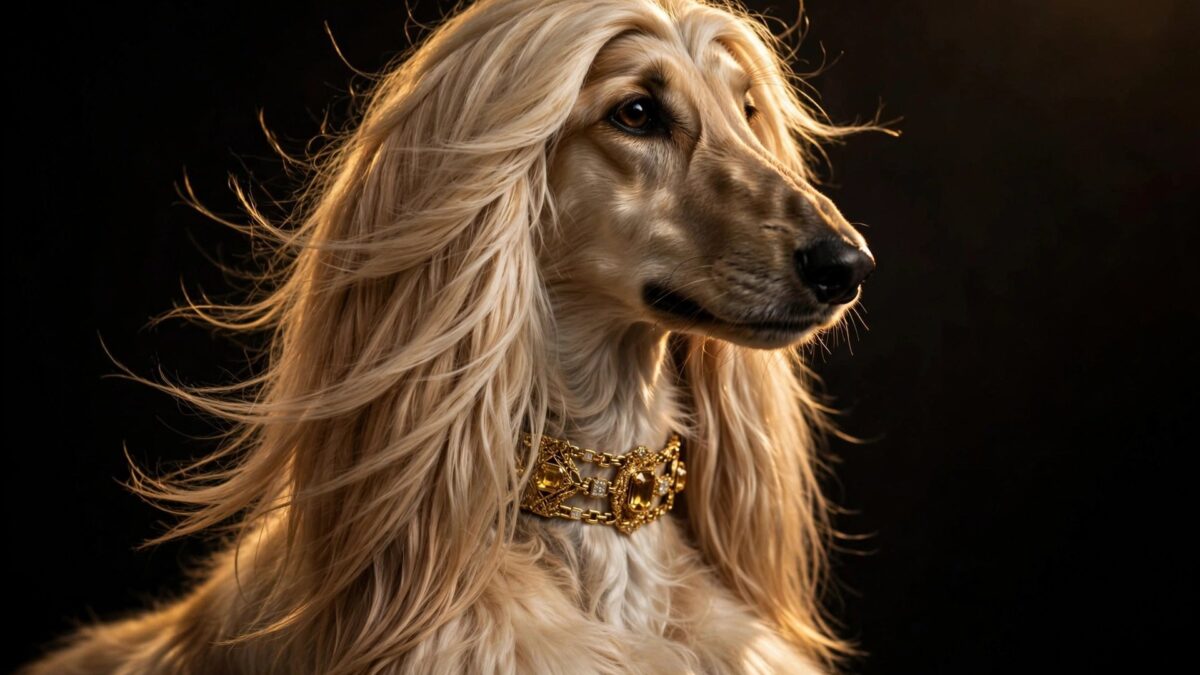
The short answer: the finest designer dog collars are built like jewelry, not accessories — full-grain leather or precious metal, solid brass or gold-tone hardware, hand-finished edges, and a fit measured to the millimeter. Below, eight collar and leash archetypes worth knowing, from the sculptural gold chain to the equestrian leather classic, plus how to measure for a couture fit.
A dog’s collar is the single most-seen thing it will ever wear. More than any coat, sweater, or seasonal costume, the collar is there every day, in every photograph, on every walk. The houses that understand this — the ones that treat a collar the way a jeweler treats a necklace — are making some of the most beautiful objects in the pet world right now. This is a guide to recognizing them.
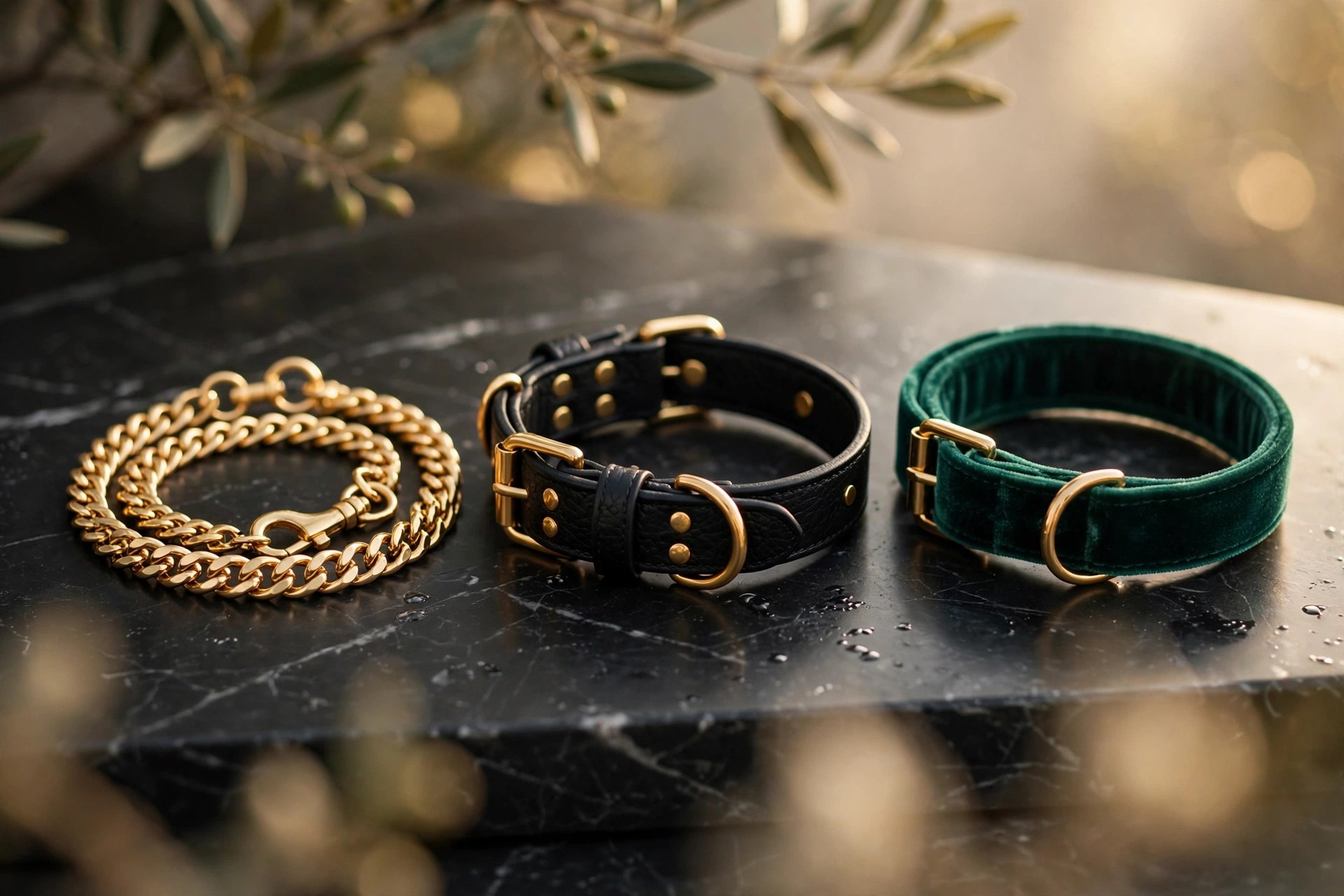
The new canon: precious metal, full-grain leather, and velvet — treated with a jeweler’s seriousness.
Why the collar is the centerpiece
Think about how a collar actually functions in a dog’s “wardrobe.” It sits at the exact point where the eye lands first — the neck, the face, the posture. A beautiful dog in a cheap collar looks like a beautiful dog wearing a cheap collar. The reverse is also true: the right collar can make an ordinary Tuesday walk feel like an occasion.
There’s a practical argument too. A collar is the one accessory that must perform under stress — a sudden lunge at a squirrel, a crowded elevator, a groomer’s table. The pieces worth their price are engineered for those moments: break strength in the hardware, stitching that won’t creep, leather that molds rather than cracks. Beauty that can’t hold a lunging greyhound isn’t luxury. It’s decoration.
What separates jewelry-grade from costume
Before the eight archetypes, the vocabulary. When you’re evaluating a designer collar — in a boutique, on a trunk show table, or online — these are the details that matter:
- Material honesty: full-grain leather (the top layer of the hide, not bonded scraps), solid brass or stainless hardware, real silk velvet rather than polyester plush. The listing should name the material precisely. Vague words like “premium” and “luxury-grade” without specifics are a warning sign.
- Hardware weight: pick the collar up. Solid brass D-rings and buckles have a heft that plated zinc never will. On a leash, the clasp should snap shut with a clean, confident click — never a mushy slide.
- Edge finishing: run your thumb along the leather’s edge. On a well-made collar it’s burnished smooth, often hand-painted, with no raw fibers. Rough edges mean the piece will fray within a season.
- Stitching: look for tight, even saddle stitching. One continuous thread, hand-sewn, outlasts machine lock-stitching on a stressed seam — this is old saddlery knowledge, and the best collar makers still follow it.
- Fit range: a serious collar offers at least five holes spaced half an inch apart, or a made-to-measure option. Two holes and a prayer is not a sizing system.
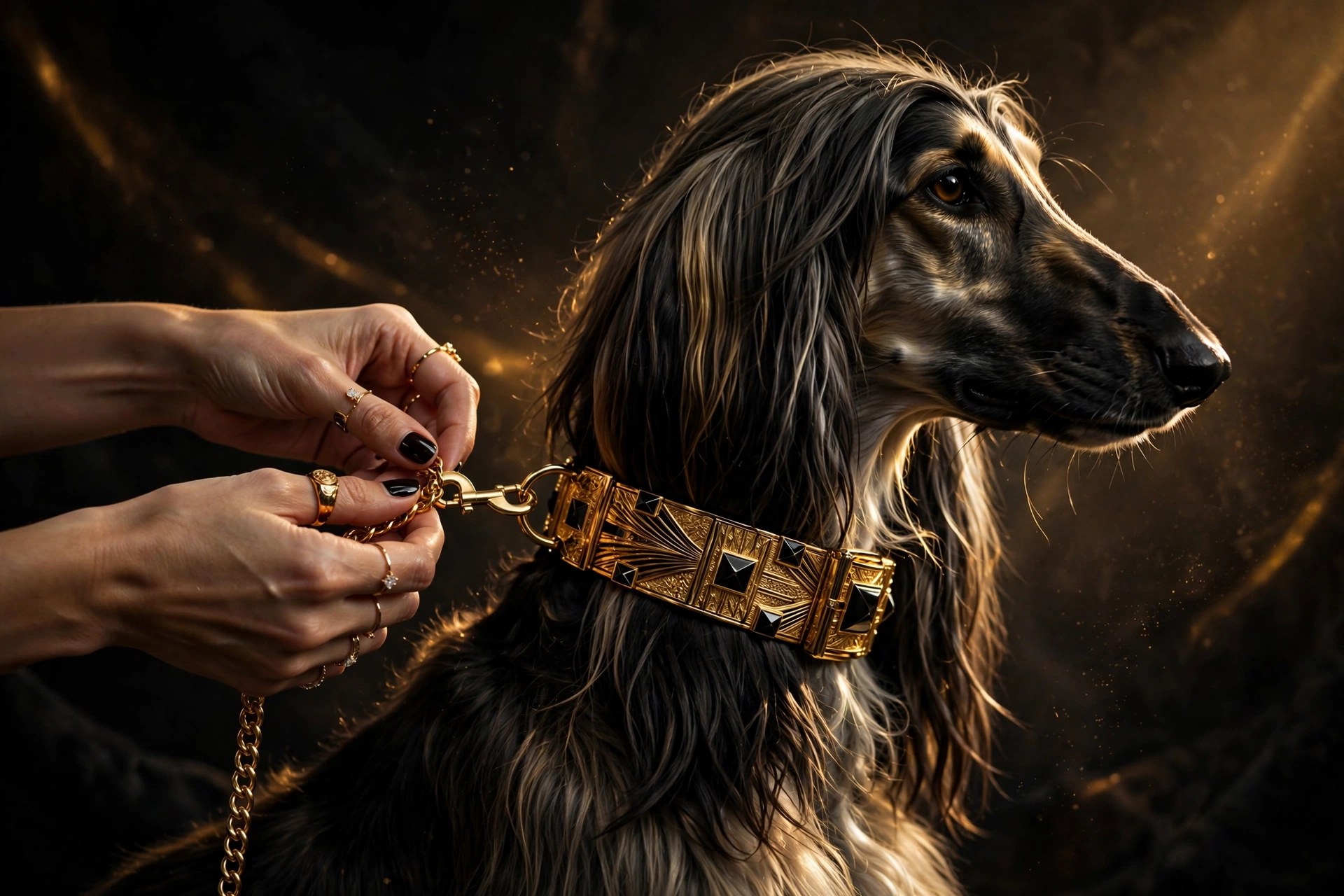
The clasp test: solid hardware announces itself. If it feels light, it is light.
Eight collar and leash archetypes worth knowing
1. The sculptural gold chain
The statement piece. A gold-tone chain collar — Cuban link, Figaro, or a flat snake chain — reads as jewelry first and dog gear second, which is precisely the point. Look for: welded (not merely bent) links, a breakaway or quick-release option for unsupervised wear, and a weight matched to the dog — a chain that suits a mastiff will drag on a whippet. Suits: short-coated, statuesque breeds — Weimaraners, Dobermans, greyhounds — where the metal sits directly against the coat.
2. The equestrian leather classic
Bridle leather, brass nameplate, hand-stitched — the aesthetic vocabulary of the stable, refined for the street. This is the collar that never looks wrong and never looks trendy. Look for: English bridle leather (vegetable-tanned, the same stock used for horse tack), a solid brass buckle, and a riveted nameplate rather than a glued one. Suits: everyone, honestly — but especially sporting and working breeds, where the heritage reads as authentic rather than costume.
3. The velvet evening collar
Silk or cotton velvet over a structured core, often in jewel tones — emerald, bordeaux, midnight. Worn the way you’d wear a velvet blazer: after dark, on purpose. Look for: a velvet pile that springs back when you brush it (crushed-flat velvet is tired velvet), and a sturdy inner band, because velvet alone has no structure. Suits: the holiday portrait, the restaurant patio, any evening the dog is part of the plan.
4. The minimalist rolled leather
A single rolled-leather cord — no flat band at all. The quietest luxury on this list, and a favorite among owners of long-coated breeds, because it parts the coat instead of matting it. Look for: a roll with no visible seam, brass or stainless end fittings, and a diameter matched to the dog’s neck (too thin reads as string; too thick reads as rope). Suits: Afghan hounds, setters, spaniels — any coat you’d rather not divide with a flat band.
5. The jeweled statement collar
Crystal, cabochon, or hand-set stones on a leather or velvet ground. The red-carpet collar. Restraint is everything here — one row of well-set stones beats three rows of glued rhinestones every time. Look for: prong or bezel settings (stones should be held, not glued), and a backing soft enough to sit against the throat. Suits: special occasions and photography; this is not a daily driver.
6. The hand-tooled western
Floral carving, basket-weave stamping, antique-finish buckles — the craft tradition of the American West applied to the dog’s neck. When done by a real tooler, each piece is effectively one of one. Look for: carving with clean, confident cuts (hesitant tooling looks muddy), dyed and sealed edges, and hardware in an antique finish that complements rather than fights the leather. Suits: ranch-adjacent aesthetics, shepherds and heelers, anyone whose boots cost more than most people’s suits.
7. The tailored fabric collar
Liberty-print cotton, Harris tweed, Japanese selvedge denim — the collar as menswear. These bring pattern and texture that leather can’t, and they age beautifully. Look for: fabric bonded to a leather or webbing core (fabric alone stretches), bound or piped edges, and hardware that matches the formality — brass for tweed, matte black for denim. Suits: terriers, dachshunds, and every dog whose owner has opinions about pocket squares.
8. The matching leash set
Not a collar at all, technically — but a collar without its leash is a sentence without punctuation. The great houses sell them as sets for a reason: matched leather, matched hardware, matched stitching, one continuous line from hand to dog. Look for: a leash in the same hide and dye lot as the collar, a clasp rated well above your dog’s weight, and a handle that fits your actual hand. Suits: anyone buying the collar above — budget for the pair from the start.
How to measure for a couture fit
A designer collar that doesn’t fit is just an expensive mistake. Measure around the middle of the neck — not at the base where collars ride, not up behind the ears — with a soft tape, and add nothing. The old two-finger rule still holds: you should be able to slide two fingers flat between collar and neck. One finger is too tight; three is a collar your dog can back out of.
When the collar arrives, the buckle should close on the middle hole, not the last one. Leather stretches slightly with wear and weather — a middle-hole fit gives you room in both directions. And re-check the fit seasonally: coats thicken in winter, and a collar that fit in July can strangle in January.
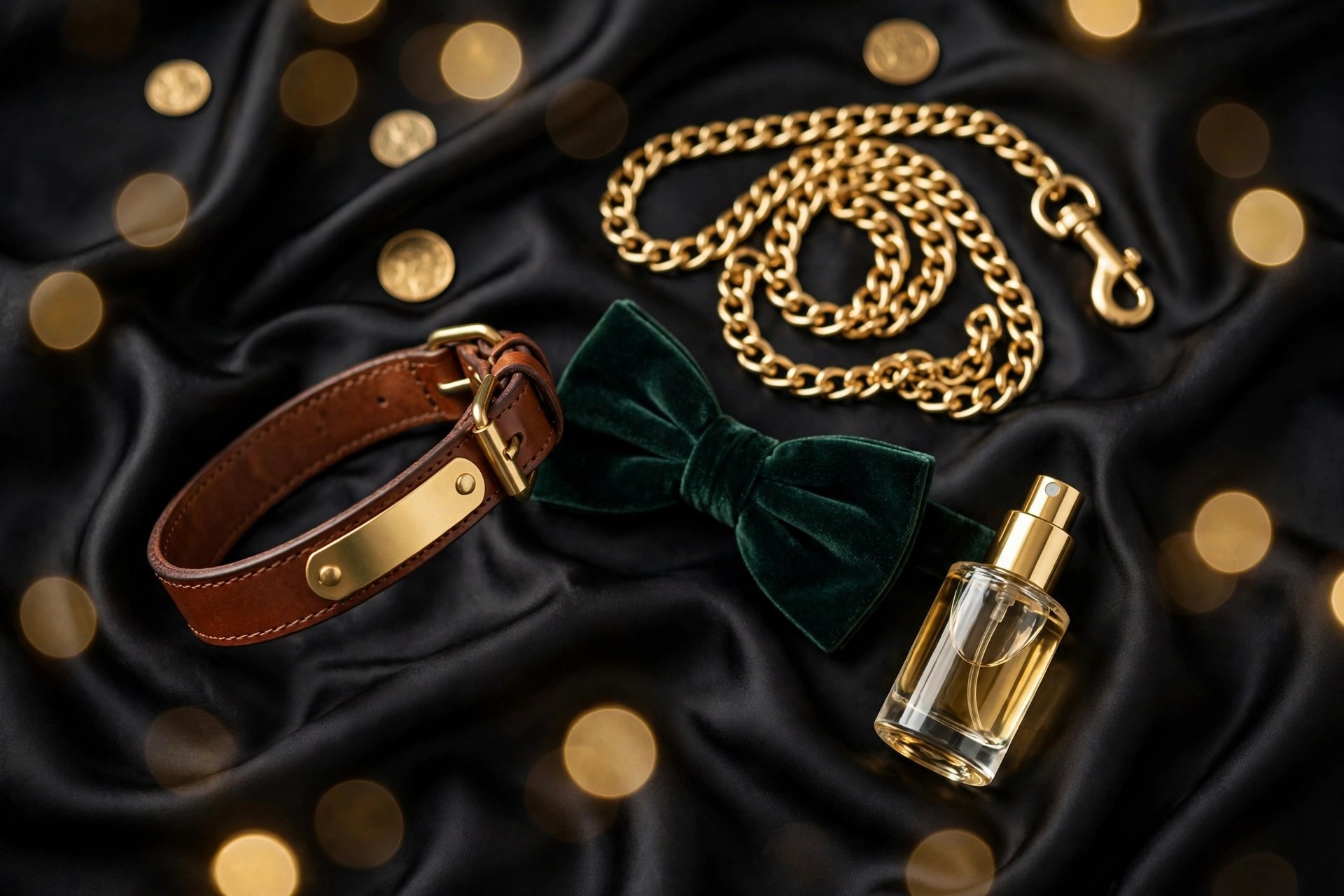
The full picture: collar, leash, and the small details that complete the set.
Frequently asked questions
Are designer dog collars actually better made, or just better marketed?
Both exist, which is why the material checklist above matters more than any logo. A genuinely well-made collar — full-grain leather, solid hardware, hand finishing — will outlast three cheap ones. A logo on bonded leather with plated zinc hardware will not. Judge the object, not the brand.
Can a dog wear a metal chain collar every day?
It depends on the chain and the dog. A well-fitted chain with welded links is fine for supervised daily wear on short-coated breeds. For unsupervised time — the yard, the crate, doggy daycare — switch to a flat collar or a breakaway design. No collar with protruding hardware should be worn unsupervised.
How do I clean a leather designer collar?
Wipe with a barely damp cloth after muddy walks, let it dry away from heat, and condition the leather two or three times a year with a quality leather balm. Never soak it, never machine-wash it, and never dry it on a radiator — heat is what kills good leather fastest.
What’s the right collar width for my dog?
As a rough guide: under 10 pounds, half an inch; 10 to 40 pounds, three-quarters of an inch; over 40 pounds, one inch or wider. Sighthounds and other long-necked breeds often wear wider martingale-style collars that distribute pressure. When in doubt, wider is kinder than narrower.
Is it worth buying the matching leash?
If the collar is an investment piece, yes — a mismatched leash undermines the whole effect, and matched sets hold their value better if you ever resell. If budget is tight, spend it all on the collar first; a beautiful collar on a plain leash still looks intentional. The reverse never does.
The collar is the one thing your dog wears every single day. Choose it the way you’d choose anything else you wear daily — for how it’s made, how it fits, and how it makes you feel when you catch sight of it across the room. The dog, one suspects, has opinions too.
This article was created with AI assistance and reviewed by our editorial team before publishing.
 A Designer Vivarium for the Panther Chameleon
 Designer Cat Furniture Built for a Maine Coon
 Luxury Dog Beds That Look Like Furniture
Leave a Reply