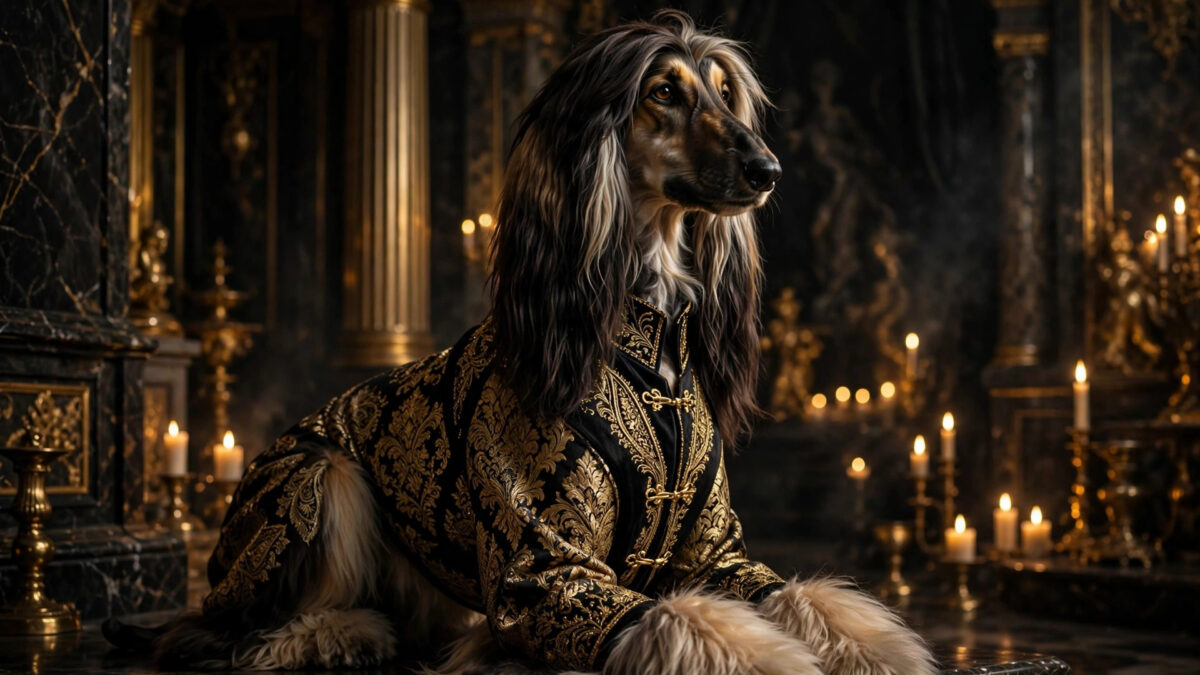
Luxury pet fashion has moved from novelty to a serious market segment: the global luxury pet apparel market was valued at $2.1 billion in 2025 and is projected to reach $4.6 billion by 2034, growing at 9.1% a year, as houses like Gucci, Moncler, and Hermès build dedicated pet collections alongside independent couture labels.
There was a time, not long ago, when dressing a dog meant a novelty Halloween costume or a clearance-rack raincoat. Those days are gone. Walk through Milan’s Quadrilatero della Moda today and you will find padded dog vests cut from the same nylon laqué as a human puffer, cashmere coats finished by hand, and carriers priced like handbags. Luxury pet fashion — pet couture, as the trade now calls it — has grown into one of the most dynamic corners of the pet industry, and it is worth understanding what it is, what it costs, and what it is actually worth buying.
How Fashion Houses Discovered the Dog
The relationship between haute couture and hounds is older than most people realise. Louis Vuitton was making monogrammed dog carriers in the early twentieth century, long before the modern pet industry existed. Barbour has outfitted country dogs in waxed cotton for generations. What changed, decisively, was timing: the past five years turned a heritage side business into a strategic category.
Three forces did the work. First, the humanisation of pets — owners who spend $248 a year per household on pet fashion and care, up from $152 in 2020, according to industry data. Second, social media: Instagram and TikTok turned well-dressed dogs into influencers with genuine commercial pull, creating a visual economy in which a recognizable coat on a recognizable dog moves product. Third, the luxury industry itself recognised the arithmetic. A $500 dog vest carries the margins of a fashion accessory with the production complexity of a child’s garment. Once one maison proved the demand, the rest followed: Gucci, Hermès, Dolce & Gabbana, Prada, Fendi, Valentino, Burberry, and Moncler have all expanded dedicated pet collections since 2022.
The Numbers Behind the Wardrobe
The figures are striking enough to quote. The luxury pet apparel segment alone was valued at $2.1 billion in 2025, projected to reach $4.6 billion by 2034 — a 9.1% compound annual growth rate. The broader pet apparel market reached $7.8 billion in 2025 and is on course for $14.2 billion by 2033. The United States alone accounts for more than 28% of global luxury pet fashion revenue.
A few more telling details: dogs represent roughly 61% of pet apparel demand, coats and jackets about a third of product sales, and online channels now capture nearly 43% of the pet apparel market, up from 28% in 2020. The category’s growth is not a blip; it is structurally tied to the same premiumisation that has lifted human luxury spending for a decade.
The Players: Houses and Ateliers
The fashion houses
Each luxury house approaches pet couture with its own accent. Gucci leads with maximalism — monogrammed canvas, bold prints, and a pet range spanning roughly $930 to $2,600, with statement pieces like its monogrammed pet beds and carriers reaching about €6,500. Louis Vuitton stays closer to its heritage: classic monogram carriers, collars, and leads in the $380–$2,690 range, aimed at owners who want the dog to match the trunk. Burberry does what Burberry always does — check, heritage, restraint — at roughly $300–$500. Ralph Lauren occupies the accessible end of designer pet fashion, with cotton and wool-blend pieces like its dog trench coat around $65–$70: preppy, understated, and an easy entry point.
Then there is Moncler, which may be the most serious of them all. Its partnership with Poldo Dog Couture — the Italian label that essentially invented the modern luxury dog wardrobe — produces padded vests in nylon laqué with logo-engraved snap buttons, retailing around $595 for the standard gilet. Farfetch lists a Moncler logo-patch knitted dog vest at £404. The craft is genuine: the same down, the same hardware language, scaled with care rather than as an afterthought.
At the very top of the market, Valentino‘s Rockstud Pet project offers personalised carriers handcrafted in Italy, with a bespoke portrait of your dog rendered on the piece — priced around €1,600. Prada‘s recycled-nylon and leather pet carriers climb above €6,000. Versace sells a crystal Medusa pet raincoat on Farfetch at £271. PUCCI asks £480 for a Marmo-print dog lead, and Maison Margiela sells a Bianchetto leather collar at £439. These are not costumes; they are house codes translated into a smaller pattern.
The independent ateliers
Arguably the more interesting half of the market belongs to brands that dress only animals. Poldo Dog Couture, founded in Italy, remains the reference point — its own-line knit coats run €215–€279, braided leather leashes €129, and its rattan tent — a woven dog hideaway — costs €699. Max-Bone (New York) and Moshiqa (Istanbul) design from a streetwear-inflected angle, while London’s Mungo & Maud and New York’s Canine Styles represent the heritage tailoring end: proper pattern blocks, proper fabric, proper fit.
The indies matter because they compete on fit and fabric rather than logo equity. A house can sell on the name; an atelier survives only if the garment actually sits well on a moving animal. The best of them cut by breed type rather than generic size, and it shows in the drape.
What Separates Couture from Costume
Price alone does not make a garment couture. Four things do.
Material honesty. The serious labels use the materials they claim: Italian wool, cashmere blends, waxed canvas, nylon laqué with genuine water-repellent finishes. Burberry’s pet pieces carry the brand’s hand-painted leather edges; Ralph Lauren uses the same cotton and wool it puts on humans. If a $400 coat is polyester with a printed logo, the label is selling you the logo — walk away.
Patterning for quadrupeds. A dog is not a small human. Leg openings, chest depth, shoulder articulation, and tail clearance all have to be engineered, not sketched. The difference between a $65 designer trench that fits and a $40 knockoff that twists on the walk is pattern work, and you can feel it in the first thirty seconds of wear.
Hardware and finishing. Look at the snaps, the D-rings, the stitching at stress points. Moncler’s logo-engraved snap buttons on its Poldo collaboration are a detail, yes — but the underlying truth is that luxury hardware distributes force and survives years of leash tension. Cheap hardware fails first, usually mid-walk.
Function as well as form. The best pieces in this market are genuinely protective: down-filled warmth for short-coated breeds, waxed cotton for rain, reflective trims for night walks. A cashmere coat that keeps a whippet warm in January is luxury with a purpose. A bejewelled collar that chafes is jewellery, not clothing.
Buying Well: A Connoisseur’s Checklist
If you are entering this world, a few rules will save you money and your dog discomfort. First, measure the dog, not the label: neck, chest at the widest point, and back length from withers to tail base. Designer sizing runs small and inconsistent between houses; a Moncler size 2 fits a 19–22 lb dog, which will surprise anyone used to American sizing.
Second, buy for your climate and your routine. A padded Moncler gilet is a sensible purchase for a Chicago winter with a greyhound; it is decorative for a pug in Miami. Third, prefer resale for statement pieces — The RealReal regularly lists authenticated Moncler x Poldo vests at 40–50% below retail, which is the rational way to buy a piece your dog will outgrow or outwear. Fourth, check wash and care before you buy: down and cashmere need proper care, and a white coat on a muddy-trail dog is a decision, not an accident.
And finally, watch the dog. The entire premise of this market is that the animal’s comfort is the point. If the ears go back, the gait stiffens, or the paw starts scraping at the chest strap, the garment fails regardless of the name on the label. Couture that the wearer hates is just an expensive disagreement.
Frequently Asked Questions
How much does luxury pet fashion actually cost?
Entry-level designer pieces — Ralph Lauren, Barbour, heritage brands — start around $65–$120. Mid-range designer pet apparel from Gucci, Burberry, and Moncler runs $300–$600. Statement and bespoke pieces climb steeply: Valentino’s personalised carriers around €1,600, Gucci’s top pet pieces near €6,500, and Prada carriers above €6,000.
Is designer pet clothing actually good quality?
The established houses generally are. They use the same materials and hardware standards as their human lines — nylon laqué, Italian wool, hand-painted leather edges, engraved snaps. The independent ateliers (Poldo, Mungo & Maud, Canine Styles) often cut better for canine anatomy since fit is their entire business. Quality varies most at the logo-licensed bottom of the market, where the brand name is rented to a mass manufacturer.
Which brands are considered the gold standard in pet couture?
Poldo Dog Couture is widely regarded as the reference atelier, and its Moncler collaboration set the template for house partnerships. Among fashion houses, Gucci and Louis Vuitton lead on breadth of collection; Moncler leads on technical seriousness; Hermès and Valentino on bespoke craftsmanship. Among indies, Max-Bone and Moshiqa are the contemporary style leaders, Mungo & Maud the tailoring standard.
Is the luxury pet fashion market still growing?
Yes, robustly. The luxury pet apparel segment was valued at $2.1 billion in 2025 and is forecast to reach $4.6 billion by 2034 — a 9.1% annual growth rate, faster than the broader pet apparel market’s 8.3%. The US accounts for over 28% of revenue, with Asia-Pacific the fastest-expanding region.
Is buying second-hand designer pet wear a good idea?
Often the smartest move. Authenticated resale platforms like The RealReal list Moncler x Poldo pieces at 40–50% below retail — a $595 padded vest for around $300. Pet garments are frequently outgrown rather than worn out, so resale condition is often excellent. Verify authenticity through established platforms rather than general marketplaces.
Pet couture is no longer a curiosity at the edge of the luxury industry; it is a category with its own ateliers, its own resale market, and its own connoisseurs. Whether it represents devotion, indulgence, or a little of both depends on the owner — but the craft, at its best, is entirely serious. The dogs, one suspects, would settle for the walk.
This article was created with AI assistance and reviewed by our editorial team before publishing.
 A Designer Vivarium for the Panther Chameleon
 Designer Cat Furniture Built for a Maine Coon
 Luxury Dog Beds That Look Like Furniture
Leave a Reply