
“Human-grade.” “Natural.” “Premium.” “Holistic.” Walk down any pet food aisle and the bags read like a luxury goods catalog — every one promising something exceptional. Here is the uncomfortable truth: of all those grand words, only a handful have any legal meaning at all. “Human-grade” is one of the few that does — it means every ingredient is genuinely fit for human consumption and the food was made in a human-food facility. “Premium” and “gourmet,” meanwhile, mean precisely nothing under the law. If you are paying luxury prices, you deserve to know which is which.
This guide decodes the label panel the way a buyer reads it — what is regulated, what is marketing, and the three lines that actually tell you whether the food in the bag is worth the price on the shelf.
The Words That Actually Mean Something
Start with the good news: a few label terms are backed by real definitions and enforcement.
Human-grade. This is the heavyweight. Under AAFCO (the Association of American Feed Control Officials, which writes the model regulations most US states adopt), a “human-grade” claim means every ingredient — and the finished product — is stored, handled, processed, and transported in line with federal regulations for manufacturing human food. It is not a vibe; it is a supply-chain standard. If a brand makes the claim, it must be able to document it.
Natural. AAFCO defines this too: ingredients derived from plant, animal, or mined sources, with no chemically synthesized additives (a few exceptions, like certain vitamins and minerals, are allowed). It says nothing about quality — bone meal is “natural” — but the term is at least policed.
Organic. This one has teeth. “Organic” on pet food falls under the USDA National Organic Program, the same system as human food, with third-party certification and audits. “Made with organic ingredients” (70%+) is a weaker tier than the full USDA Organic seal (95%+). Check which one you are looking at.
“Complete and balanced.” The single most important phrase on any bag or can. It means the food meets AAFCO nutrient profiles for a stated life stage — growth, adult maintenance, or all life stages. Without it, you are buying a snack or a supplement, not a diet. Everything else on the label is secondary to this line.
The Words That Mean Nothing
Now the marketing department’s greatest hits — terms with no AAFCO or FDA definition whatsoever:
- Premium / super-premium. No definition. A $20 bag and a $90 bag can both say it.
- Gourmet / luxury. Pure adjective. Unregulated.
- Holistic. Sounds scientific; legally, it is decoration.
- “Vet recommended” / “vet formulated.” There is no registry of such claims and no required standard behind them. A single consulting vet’s signature can justify the line.
This does not make the food bad — many excellent foods use these words. It means the words themselves are not evidence. Judge the food by the regulated parts of the label, not the poetry on the front.
Reading the Ingredient List Like a Buyer
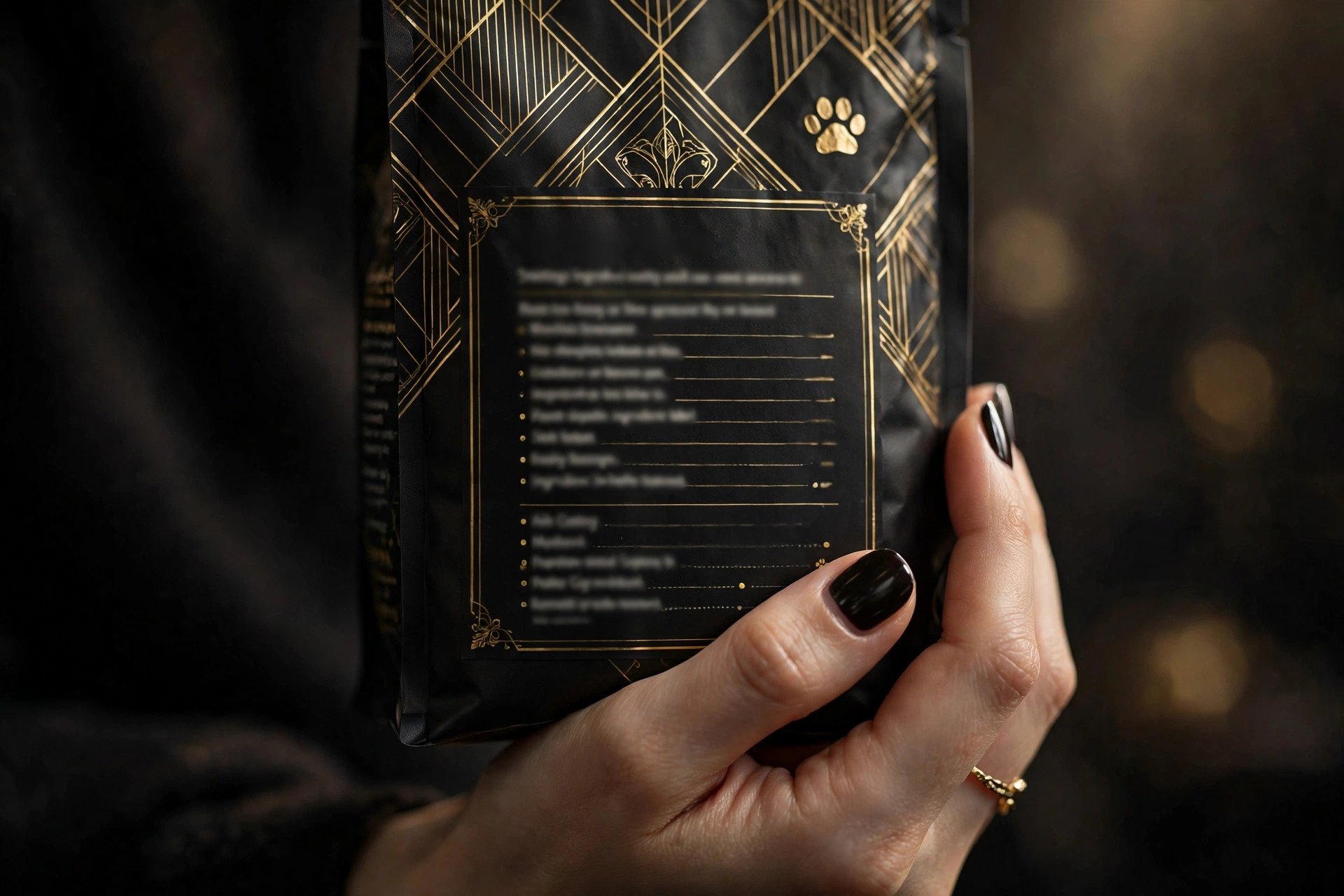
Ingredients are listed in descending order by weight before cooking — and water is heavy. That is why fresh chicken often leads the list even in foods that are mostly grain by dry weight. It is not a lie, but it is worth knowing.
Watch for ingredient splitting: the same plant broken into “peas,” “pea starch,” and “pea protein” so each appears lower on the list than a single combined entry would. If you mentally recombine them, the picture sometimes changes.
Learn the hierarchy of animal ingredients. Named meals (“chicken meal,” “salmon meal”) are concentrated protein — the water is already removed — and are perfectly respectable. Vague terms like “meat meal” or “animal fat” tell you nothing about the source; named sources (“chicken fat”) tell you everything. Specificity is the luxury signal here: the more precisely a brand names its ingredients, the less it has to hide.
One more buyer habit: scan for the sweeteners and the danger ingredients in treats and toppers. Xylitol — sometimes listed as birch sugar — is extremely toxic to dogs even in small amounts, and it shows up in products you would never suspect.
🔍 Is xylitol safe for dogs? — Eaoae
The Guaranteed Analysis Trap
The guaranteed analysis panel shows minimums and maximums — crude protein (min), crude fat (min), fiber (max), moisture (max). Two traps hide here.
First, the numbers are on an as-fed basis, water included. A canned food at 78% moisture listing 10% protein sounds anemic next to a kibble listing 28% — until you convert both to a dry-matter basis. The math: subtract moisture from 100, then divide the nutrient by the result. That canned food is 10 ÷ 22 = 45% protein on a dry-matter basis. Suddenly it is the richer food. Always compare dry-matter to dry-matter.
Second, “crude protein” measures nitrogen, not quality. Feather meal tests high in crude protein and is nearly indigestible. The number tells you quantity; the ingredient list tells you quality. You need both.
Formulated vs. Feeding Trial
Flip to the AAFCO statement and read the fine print. There are two ways a food earns “complete and balanced”:
- Formulated to meet AAFCO profiles — the recipe was calculated on paper to hit the nutrient targets. Cheaper to do; no animals were fed the food in testing.
- Animal feeding tests using AAFCO procedures — the food was actually fed to dogs or cats in controlled trials. More expensive, more convincing.
Neither is a guarantee of greatness, but when two luxury-priced foods sit side by side, the one with feeding-trial substantiation has done more homework. It is a reasonable tiebreaker.
Five Questions Before You Pay Luxury Prices
Use this as your checkout ritual:
- Does it say “complete and balanced,” and for which life stage? If not, it is not a diet.
- Can you name every animal ingredient’s source? Named meals and fats beat mystery meals.
- What is the protein on a dry-matter basis? Do the 30-second math before comparing cans to kibble.
- Feeding trial or formulated? Prefer the one that was actually fed.
- Who answers the phone? Call the number on the bag with one question — where is this food actually manufactured? Brands that own their kitchens answer proudly; brands that deflect, deflect.
That last question is the luxury test. True luxury in any category is accountability: a maker who will stand behind the product with a name, a place, and a process. The bag that can answer all five is usually worth its price. The bag that leans on “gourmet” and “holistic” instead is selling you the adjectives.
This label guide is one chapter of a larger story. In our complete breakdown of premium pet nutrition: fresh, human-grade and gourmet food, explained, we put the claims in order — and do the cost-per-day math that tells you what the words are worth.
Frequently Asked Questions
Is human-grade pet food actually better for my pet?
It guarantees ingredient sourcing and manufacturing standards, which is meaningful — but it does not automatically mean the recipe is nutritionally superior. A human-grade food still needs the “complete and balanced” statement and a sound formulation. Think of it as a quality floor for ingredients, not a ceiling for nutrition.
Does “natural” mean a food has no preservatives?
No. “Natural” restricts chemically synthesized ingredients, but naturally derived preservatives like mixed tocopherols (vitamin E) or rosemary extract are permitted and widely used. If you want to avoid preservatives entirely, you need to read the ingredient list — the word “natural” alone won’t tell you.
What is the single most important line on a pet food label?
The AAFCO nutritional adequacy statement — the “complete and balanced for [life stage]” line, and whether it was established by formulation or by feeding trials. It is the only part of the label that directly certifies the food as a proper diet.
Are by-products automatically bad?
Not necessarily. Named by-products (e.g., “chicken by-products”) can include nutritious organ meats. The issue is vagueness, not the category — unnamed “meat by-products” tell you nothing about source or quality. Judge the specificity, not the word.
The Pet’s Palace Journal is an editorial publication, not veterinary advice. For questions about your individual pet’s diet, consult your veterinarian.
This article was created with AI assistance and reviewed by our editorial team before publishing.
 Feeding an Irish Wolfhound, the Gourmet Way
 Premium Pet Nutrition: Fresh, Human-Grade and Gourmet Food, Explained
 Bone Broth and Meal Toppers: A Gourmet Finishing Touch
Leave a Reply